At a glance: Plan a radiator cover without assuming acoustic felt lets heat through. Check air openings, material clearances, valve access and the effect on heat output.
Table of contents
A radiator cover is more than a decorative wall
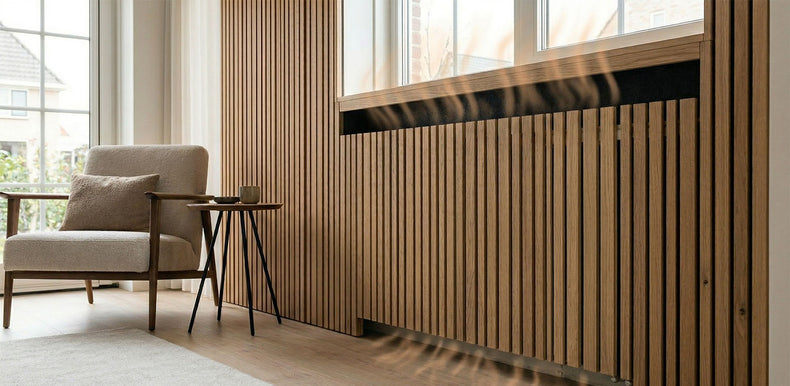
Slats can help a radiator sit more comfortably within an interior, but a cover changes the way air and heat move around it. It is not realistic to promise zero heat loss. The layout must retain suitable airflow, material clearances and access to controls, based on the radiator manufacturer’s instructions.
Felt-backed panels are not an open grille
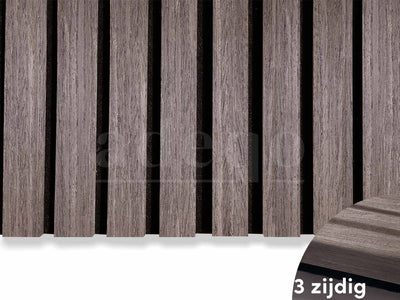
A standard acoustic panel has a continuous felt backing. Although there are gaps between the slats, the assembly is not the same as independent slats in an open radiator grille. Do not assume that visible gaps guarantee unrestricted air movement. A custom cover may need a different open construction; check the design before choosing materials.
Measure the equipment and access points
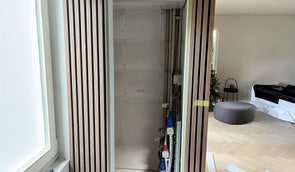
Measure the radiator, valves, pipework and the space needed to maintain or remove it. Identify the required lower air inlet, upper outlet and clearances from the manufacturer’s documentation. A removable front can retain access, but its fixings and frame must remain stable. Do not attach a decorative enclosure in a way that interferes with the radiator.
Choose materials with heat in mind
Indoor wood veneer panels are not intended to sit against a direct heat source. Temperature and drying can affect wood, MDF and adhesives. B-s1,d0 does not mean a material is non-combustible or automatically suitable beside any heater. Have the design reviewed where suitability is uncertain.
Decide whether a cover is worth the compromise
Sometimes treating the surrounding wall gives the desired visual result while leaving the radiator unobstructed. If you prefer an enclosure, discuss its effect on heat output with a heating professional and follow the equipment instructions. Adeqo can advise on slat dimensions and finishes, while the radiator-specific construction should be checked for your installation.
Plan your project with Adeqo
Compare acoustic wall panels, order finish samples or contact the team for advice. For commercial projects, apply for a business account.

| Cover type | Heat output | Appearance | Access |
|---|---|---|---|
| Closed MDF enclosure | Can restrict airflow; assess design | Plain finish | Depends on design |
| Open grille | Check equipment instructions | Functional | Can be removable |
| Slat enclosure | Design-dependent; felt-backed panels are not an open grille | Wood finish | Must retain access |
| Metal enclosure | Check equipment instructions | Modern | Depends on design |


How should I plan a wood slat radiator cover?
Follow the radiator manufacturer’s ventilation and material-clearance instructions. Standard acoustic panels have a felt backing and are not an unrestricted open grille. A cover can reduce heat output, so do not assume zero heat loss. Keep valves and equipment accessible and have the proposed construction checked by a heating professional.
How should I plan a wood slat radiator cover?
Follow the radiator manufacturer’s ventilation and material-clearance instructions. Standard acoustic panels have a felt backing and are not an unrestricted open grille. A cover can reduce heat output, so do not assume zero heat loss. Keep valves and equipment accessible and have the proposed construction checked by a heating professional.
How should I plan a wood slat radiator cover?
Follow the radiator manufacturer’s ventilation and material-clearance instructions. Standard acoustic panels have a felt backing and are not an unrestricted open grille. A cover can reduce heat output, so do not assume zero heat loss. Keep valves and equipment accessible and have the proposed construction checked by a heating professional.